GTD: Against New Year's Resolutions
The new year is here and, with it, a fresh opportunity to feel like a failure. Do you have some worthy resolutions for 2027, but are already sensing they might not work out? You’re not wrong.


The new year is here and, with it, a fresh opportunity to feel like a failure. Do you have some worthy resolutions for 2026, but are already sensing they might not work out? You’re not wrong. The research shows that between 85% and 90% of all new year’s resolutions break down in the first two months.
There has always been a wide gap between our well-meaning present self, and the future self who actually has to lace up those running shoes. But, there’s more going on here than mere laziness. Having repeatedly failed at my own resolutions, I’m beginning to think they’re just not a good way to achieve anything.
Fortunately, there are more effective strategies.
Goals to Actions
Perhaps the biggest reason New Year’s Resolutions don’t work is that they’re so often expressed in terms of goals or aspirations. Typically, you resolve to get fit, develop a better relationship with your kids, or get promoted at work. All worthy aims, but goals are not something you can control. There is no magic wand that will make you fitter, and so on.
Which is not to say goals are useless. It’s just that they are neither the end nor the beginning of achievement. So, start the new year properly by taking some time to look back over the previous twelve months. See what worked and what didn’t. Identify which pursuits fulfilled you and which were a waste of time. Did you get caught up with fads other people said were important, but which brought you no value? Which accomplishments genuinely made you proud? And, what is there still left to do?
Use this review to set a direction, or theme, for the new year that aligns with your core values and aspirations. That should produce two or three (try to make it no more than four) goals you’d like to work on. Most people stop here, but the next step is the essential one. For each goal, identify a specific, achievable, and concrete daily action you can undertake to achieve it. This turns the goal into an activity — which is something you can control. (Not to get too philosophical, but our actions may be the only thing we ever do control).
If your goal is to get fit, for example, set aside fifteen minutes every morning for a run. If to write the great Canadian novel, spend an hour each day writing. To build a better relationship with your kids, you could designate a time for family activities.
These might not seem very ambitious, but I guarantee that small activities like these, practiced consistently, will accomplish far more than any grand effort that fizzles out after a week or two. Better yet, choosing a few regular activities, with a set time and place for each, creates a plan for the new year. You can even demonstrate your commitment by writing it down.
Goals, on their own, are just wishes; plans are how we make them happen.
Actions to Habits
Of course, for small activities to make a big difference, you need to keep them going long after the excitement of the new year has worn off. They need to become part of your normal routine, not something you pick up for a while and then drop. Do this, and they will eventually become habits, at which point it becomes almost easier to do them than not.
A lot has been written about establishing new habits. This is the most helpful advice I’ve found:
- Pick no more than four goals for the new year. Making lasting change is hard, and it’s not realistic to completely upend your routine. Your New Year’s plan should consist of two or three — at the very most four — goals.
- Identify a single, concrete action to support each. A concrete action is one you can picture in your mind. The more specific it is, the easier it is to get started on it every day.
- Be specific about where and when. When you’re trying to establish habits, it’s incredibly helpful to associate new activities with a time and place. Those become identified with the activity, making it easier to get started.
- Harness the power of ritual. We tend to think of rituals in a religious setting, but running through a set of specific actions, the same way each time, before an activity can be a great way to ease into it. Keep your running gear in a specific place, for example, and you could make a ritual of getting dressed and lacing up your shoes.
- Don’t be too ambitious. As mentioned above, consistency is more important than trying to do too much each day. If you look at the routines of accomplished people, it’s amazing how little time most of them spend daily on their creative work. But they show up, and do the work, with incredible regularity.
The great thing about habits is the way they eventually become a part of your identify. Keep running for fifteen minutes every morning, and you stop thinking of yourself as someone who’d like to get fit. You become a runner.
There’s real power in that.
Do it Daily’ish
If consistency is the key to success, you need a system for holding yourself accountable (at least until your new habits become set). The simplest is probably a good old-fashioned paper calendar. Just hang it in a visible place and mark an “X” each day you follow through on your New Year’s Activities. Famously, comedian Jerry Seinfeld tracks his creative work this way (with an X for each day he spends an hour writing jokes).
The only danger with habit tracking is that it’s a little too easy to become focused on the ever-growing chain of X’s in your calendar. Seinfeld has even been quoted on the importance of “not breaking the chain”.
Which can make you feel like a failure when, inevitably, you do break the chain. This is neither healthy nor helpful. Failure can become a part of your identity, too, at which point you might as well eat a giant tub of ice cream as climb the mountain it would take to rebuild your magnificent chain of X’s.
That’s not being fair to yourself. In the real-world people get sick, the babysitter cancels, you’re called into work early, or something else happens to wrest control of the day away from you. No amount of discipline, then, can prevent you from breaking the chain.
Interestingly, Oliver Burkeman (author of 20,000 Weeks) had a chance to ask Jerry Seinfeld about “breaking the chain”. Seinfeld was amazed that anyone would need telling about the importance of showing up regularly and doing the work if you want to get better at something. And, he was surprised that this would be misunderstood as meaning you could never, ever miss a day.
So, while activity tracking is essential for accountability, it’s also important to keep the focus where it belongs — doing the work, rather than some arbitrary standard of perfection.
- Begin by setting an achievable weekly goal for each of your New Year’s Activities (six runs, for example, or five family time sessions of an hour each).
- Then, as before, mark each day that you successfully complete these activities; you can use a different symbol for each (an “X” for runs, a square for family times, and so on).
- At the end of the week, put a giant check mark in the margin for each target you met.
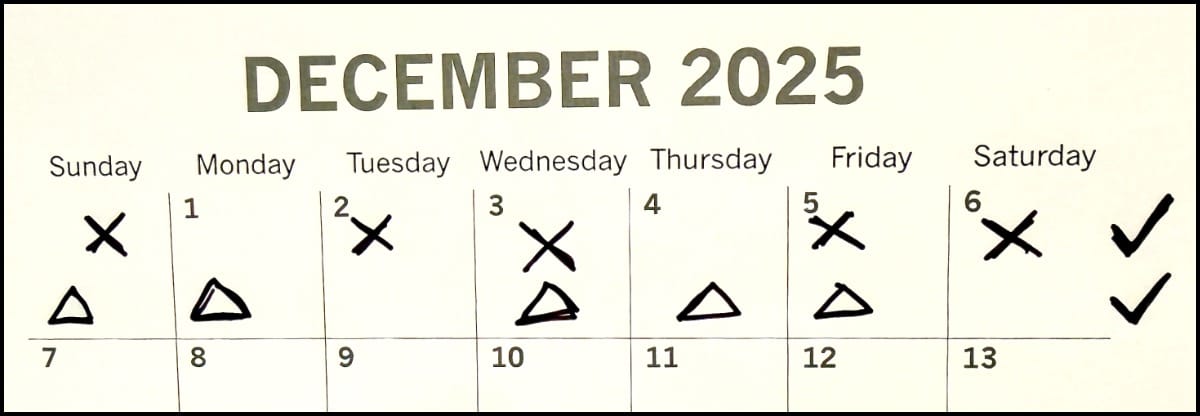
These weekly check marks are now your chain — one with a bit of “give” in it.
You can even allow substitute activities when your normal routine isn’t possible. If you’re travelling, for example, and can’t run, give yourself an “X” for a fifteen-minute workout in the hotel gym instead. And, at least a couple of times a year — during holidays or recovery periods — don’t be afraid to give yourself a week off. Just draw a line through that week and take it out of the system, rather than show it as a break in your streak.
If a paper calendar is too low tech for you, there are smartphone apps for habit or “streak” tracking. The more sophisticated let you set a target goal for each week. Whether you prefer paper or digital, that’s the important thing: being able to set your own standard for success, rather than let the universe impose an impossible dream of perfection from on high.
Burkeman refers to this as doing your work “daily’ish”, which sounds about right!
Review Quarterly
The final problem with New Year’s Resolutions is that they’re for a whole year! That’s just too damn long for any good intention to last. Or any New Year’s Plan.
Not all your activities will work as well as you hoped. Your circumstances might change, and your goals with them. So, rather than lose a full year, it’s better to have a system of periodic reviews for checking-in and making any necessary adjustments. A month is too short to see whether the new habits are sticking, so every three months is probably a good interval for most.
This quarterly review allows you four opportunities a year to check your goals, refine your activities, and start fresh, if necessary. As always, the best way to ensure it happens is to block time in your calendar. (Go ahead and mark your calendar now; I’ll wait. A half hour to an hour each for your next four quarterly reviews should be plenty.)
At each quarterly review:
- Check your goals to see if they’re still relevant.
- If not, should you drop them and their related activity?
- If you do drop a goal, is there another goal that should take its place?
- In which case, identify an activity to go with it, and add it to your plan (with a daily time and location). - For each of your ongoing activities, check whether:
- You are regularly sticking to your plan, and- if not, why not:
- Do you need to pick a different activity for that goal?
- Or do you need to find a better time or place to make this activity more sustainable?
- if not, why not:
The great thing about quarterly reviews is that you make these adjustments before you’ve lost a whole year. In fact, you have three more quarters to get it right.
I think it’s healthy, too, that this treats your plan as an ongoing process, rather than as something that starts with New Year’s and concludes when the year is done. Each review isn’t an end, where you declare success or failure, but a course-correction, where you can make any necessary adjustments. This accords with the rhythm of our lives, which don’t start and stop at arbitrary dates (like 1 January).
Once quarterly reviews become part of your routine, you may even find that New Year’s is no longer a big deal — just time for the next quarter’s scheduled review.
That’s a good thing!
Finis
Self-improvement advice should always be taken with a grain of salt. Humans are incredibly varied, and you might not be a calendar blocker (in which case, there are other ways to track habits). Or, you might be that rare detail hound who can handle more than four new activities a quarter.
I think the core principles here are sound, though. It matters that your goals be aligned with your values and aspirations. And you reach your goals by doing the work, day after day.
There’s a gentleness about this approach I like. Without arbitrary deadlines and standards, the focus stays where it belongs: learning and getting better, a little bit each day.